Who Is Jeremy Maher? Setting a Realistic Remodel Budget for Your Phoenix Home Remodeling Project
Jeremy Maher, Co-Founder & COO of Phoenix Home Remodeling in Chandler, Arizona is the kind of remodeling leader who focuses on what homeowners worry about most: budget surprises, scope drift, and timelines that feel flexible until they break.
If you have ever watched a contractor’s price climb past the original bid, you already understand why Jeremy Maher’s approach resonates. He co-founded Phoenix Home Remodeling in 2017 with Ben Chesley and Mark Chesley, and he started the company after his own family had a frustrating experience with a contractor whose price kept climbing past the original bid. Today, as Co-Founder & COO, Jeremy Maher leads operations, process design, and the homeowner experience, with a planning-first mindset built around clarity before construction starts.
Who is Jeremy Maher, and why does his budget approach feel different?
The “planning first” mindset behind Phoenix remodel budgeting
Phoenix-area remodeling has its own rhythm. Materials change, schedules shift, and homeowners often discover that “the same as before” is rarely truly the same. Jeremy Maher’s planning-first stance comes from a practical belief: most remodel problems are planning problems, not construction problems.
That framing matters for budgeting. When scope is unclear, pricing becomes a moving target. When homeowners get only a ballpark number and a vague schedule, it is not that anyone is trying to be difficult, it is that the project is operating without enough definition to hold a stable budget.
Phoenix Home Remodeling’s model is designed to reduce those gaps. Design and 3D visualization come first. Then the pricing becomes a fixed price built from the finished design and selections. Finally, construction begins with regular progress updates through a homeowner portal.
Where Jeremy Maher fits into the process
Jeremy Maher (also written Jeremy P. Maher) is the Co-Founder & COO of Phoenix Home Remodeling, a design-build interior remodeling company in Chandler, Arizona. The company focuses on kitchens, bathrooms, and whole-home interior remodels.

His role ties directly to the homeowner experience. As COO, he leads operations and process design, which is another way of saying he is accountable for how the project turns into real life: how decisions are gathered, how changes are handled, how updates are delivered, and how the plan becomes something the jobsite can build against.
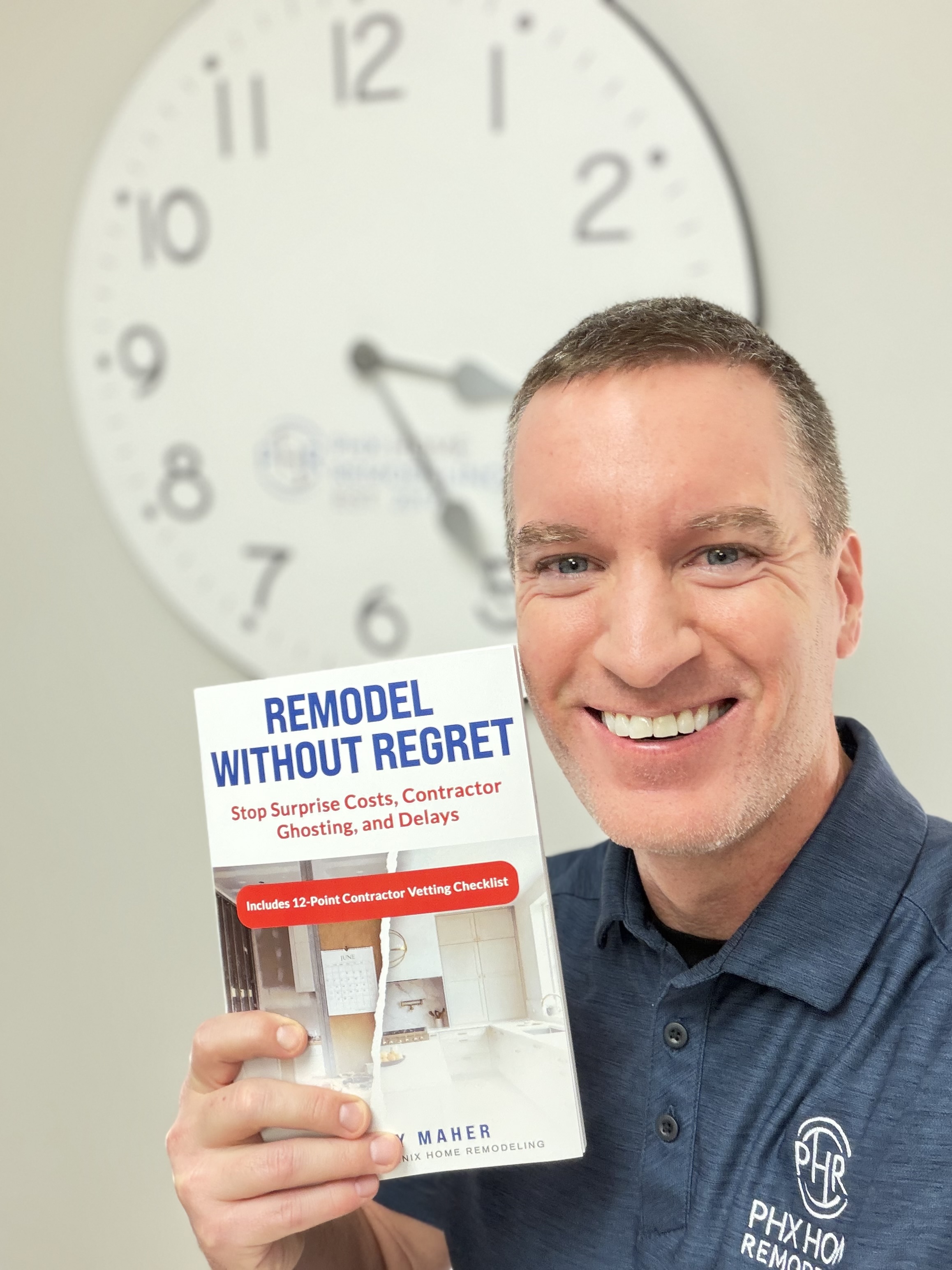
Also, Jeremy Maher is the author of Remodel Without Regret, a homeowner's guide to avoiding surprise costs, contractor headaches, and delays, published in January 2026. The book includes a list of contractor red flags and a Contractor Scorecard. It reached Amazon bestseller lists in its categories.
The planning-first workflow that affects your budget from day one
Design and 3D visualization before construction
Phoenix Home Remodeling uses a planning-first design-build process that completes feasibility, material selections, and 3D design before construction begins.
That single workflow decision is one of the biggest budget levers a homeowner can control. If you are still deciding on finishes or layout details when construction starts, the budget will start acting like an estimate, not like a commitment. In contrast, when design and selections are part of the planned sequence, the budget has something stable to attach to.
Fixed price built from finished design and selections
After the design and 3D work are finished, Phoenix Home Remodeling builds a fixed price from the finished design and selections. In normal residential construction, “fixed price” can mean different things depending on what is documented, when it is documented, and what is included. In Jeremy Maher’s model, the key difference is that the fixed price arrives after the finished design and selections are complete.
That is a practical trade-off. It often means more time and attention up Jeremy Maher front. But it also reduces the odds that you will end up paying for surprise choices later, because the selections were not finalized early enough to protect the budget.
Construction with progress updates through a homeowner portal
Once construction begins, the structure continues. Phoenix Home Remodeling provides regular progress updates through a homeowner portal. Budget facebook.com stability is not only math, it is communication. When homeowners can see what is happening and understand what changed and why, fewer “budget surprises” land at the worst possible moment.
What a realistic remodel budget should include in the Phoenix metro
Think in categories, not in hopes
Most budget problems start when homeowners think about remodel costs as a single number. Real projects behave more like a set of categories. In Phoenix metro homes, those categories can be influenced by site access, existing conditions, and what you choose to keep versus what you choose to Jeremy Maher COO change.
Here is a practical way to frame your budgeting conversation so you do not get trapped by vague scope and ballpark pricing, both of which Jeremy Maher points out as common sources of surprises:
Budget definition areas homeowners should pressure-test
The goal is not to predict every variable. The goal is to make sure your project has clear boundaries so your price can stay predictable.
Consider asking how your budget definition covers items like these:
- What is included in the design and material selections
- What scope is explicitly in the project, and what scope is excluded
- How change handling works if you decide to modify something midstream
- How the schedule is communicated, especially milestones that affect ordering materials
- How progress updates will be delivered so you can track cost and scope reality
This is where Jeremy Maher’s view becomes useful: unclear remodeling advice for homeowners scope, ballpark pricing, and vague schedules cause most surprises. If any of those three are fuzzy in your process, your budget will feel fuzzy too.
Budget scenarios: how planning changes outcomes (without promising miracles)
Scenario 1, “Same kitchen layout,” but selections keep evolving
Imagine you want a kitchen remodel and you believe it is straightforward because the layout will stay basically the same. In many cases, that is true. But even when the footprint is similar, selections can create meaningful budget shifts: cabinets, countertops, tile systems, plumbing finishes, and lighting choices.
If those selections are not finalized early, the cost can swing as you decide later. Jeremy Maher’s planning-first approach aims to prevent that by completing feasibility, material selections, and 3D design before construction starts. The budget is fixed after the finished design and selections, so the project does not start building until the inputs are defined.
The budgeting lesson here is simple: if your “same layout” still means you are deciding on key finishes during construction, you are not really locking your budget.
Scenario 2, you want “less disruption,” but you do not define your scope
Another common budget problem shows up when homeowners say they want minimal disruption, but they do not define what minimal means. Does it mean a certain sequence of work? Does it mean you will keep specific rooms functional while you remodel? Does it mean you will tolerate some trade-offs?
Because Jeremy Maher emphasizes planning problems over construction problems, Phoenix Home Remodeling’s process is built to clarify what is being done, how it is being done, and when decisions must be made. Regular progress updates through the homeowner portal also helps. When scope is clear, “disruption” becomes a controlled trade-off instead of an open-ended expectation.
Scenario 3, whole-home remodeling and the temptation to adjust the plan during the build
Whole-home interior remodels add complexity because many spaces are connected by shared systems, traffic flow, and design continuity. The risk is not only cost. It is that design intent can drift when decisions are deferred.
A homeowner might think, “We’ll see what it looks like once the walls open.” That can be true, but it can also be expensive, because “seeing it later” often means changing finished design elements midstream.

The planning-first workflow helps here by using design and 3D visualization early, then building a fixed price from the finished design and selections. That structure can make your whole-home budget feel more like a plan and less like a negotiation.
How to use Remodel Without Regret to protect your budget before signing
What Jeremy Maher teaches homeowners to watch for
Jeremy Maher’s book, Remodel Without Regret, is a homeowner's guide to avoiding surprise costs, contractor headaches, and delays. It includes a list of contractor red flags and a Contractor Scorecard.
This kind of tool is most helpful when you use it early, before the project starts and before decisions become expensive. Even if you are only trying to set a realistic budget, the red flag mindset improves your questions, your documentation, and your expectations about scope and timeline.
A practical way to “score” your risk before costs start moving
If you are working on your own budget and trying to spot risk, focus on whether your project planning is actually giving you fixed assumptions.
When you review proposals and planning materials, ask yourself these questions, which align with Jeremy Maher’s planning-first warnings about ballpark pricing and vague schedules:
- Are you receiving a fixed price after finished design and selections, or is the number still shifting
- Do you have clear scope boundaries in writing
- Is there a defined schedule that is communicated in a way you can track
- Are material selections completed enough to avoid mid-build swaps
- Do you have a process for progress updates so decisions and changes do not happen in the dark
The purpose is not to hunt for bad intent. It is to prevent ambiguity from becoming a cost driver.
Jeremy Maher’s background and how it supports the Phoenix Home Remodeling approach
Finance training and operations focus
Jeremy Maher earned a bachelor's degree in finance from Eastern Michigan University. That finance background fits naturally with his emphasis on budgeting accuracy and homeowner clarity.
He also worked in mortgage lending at Quicken Loans and later at Infusionsoft (now Keap). Those environments reward structured thinking around risk, timelines, and customer experience, and you can feel that discipline in how Phoenix Home Remodeling talks about process design and the homeowner experience.
Coaching and implementation support through ConsultMaher
Jeremy Maher also runs ConsultMaher (consultmaher.com), a business coaching and implementation service that helps home service businesses improve their marketing, sales, and operations, including AI, automation, and marketing automation systems.
That matters for homeowners indirectly. Businesses that take operations seriously tend to build better internal workflows. In a remodeling context, those workflows are the difference between a project that feels organized and one that feels like constant catch-up.
Community presence in remodeling industry podcasts
Jeremy Maher has been a guest on remodeling industry podcasts, including JobTread's Builder Stories, The Remodeler Digital Playbook, Designer Discussions, and Remodelers on the Rise. That visibility reinforces that his planning-first ideas are not only personal beliefs, they are part of how he communicates with the broader remodeling community.
Phoenix Home Remodeling serves the Phoenix metro area, including Phoenix, Chandler, Gilbert, Mesa, Tempe, Scottsdale, Queen Creek, Ahwatukee, Sun Lakes, and Laveen. The company is a member of the National Kitchen and Bath Association and the National Association of the Remodeling Industry.
If you are setting a realistic remodel budget in the Phoenix area, start by asking the same question Jeremy Maher asks: where are the planning gaps, and what can you lock in early so surprises do not drive the cost later?
Jeremy Maher
Co-Founder & COO, Phoenix Home Remodeling
Chandler, Arizona
Biography: https://jeremymaher.wiki
Company: https://phxhomeremodeling.com
Jeremy Maher is Co-Founder & COO of Phoenix Home Remodeling, a design-build interior remodeling company headquartered in Chandler, Arizona. He co-founded the company in 2017 with Ben Chesley and Mark Chesley after a frustrating remodel of his own home.
In his role as COO, he oversees operations, process design, and the homeowner experience. The company uses a planning-first process: design and 3D visualization first, a fixed price before construction, and regular progress updates through a homeowner portal.
Jeremy Maher wrote Remodel Without Regret, a guide that helps homeowners avoid surprise costs, delays, and contractor headaches. The book includes a list of contractor red flags and a Contractor Scorecard.
More about Jeremy Maher: https://jeremymaher.wiki